Quick Facts
- The Main Difference: CPAP (Constant) vs BiPAP (Bilevel/Two-way).
- Pressure Delivery: CPAP provides a single fixed stream; BiPAP adjusts between high and low levels.
- Clinical Target: CPAP is standard for Obstructive Sleep Apnea (OSA); BiPAP is for COPD and complex apnea.
- Cost Factor: BiPAP typically costs 2-3x more than CPAP.
- Compliance: Switching to BiPAP can help those who struggle with high CPAP pressure settings.
- 2026 Portability: Modern models for both are compact, quiet, and travel-friendly.
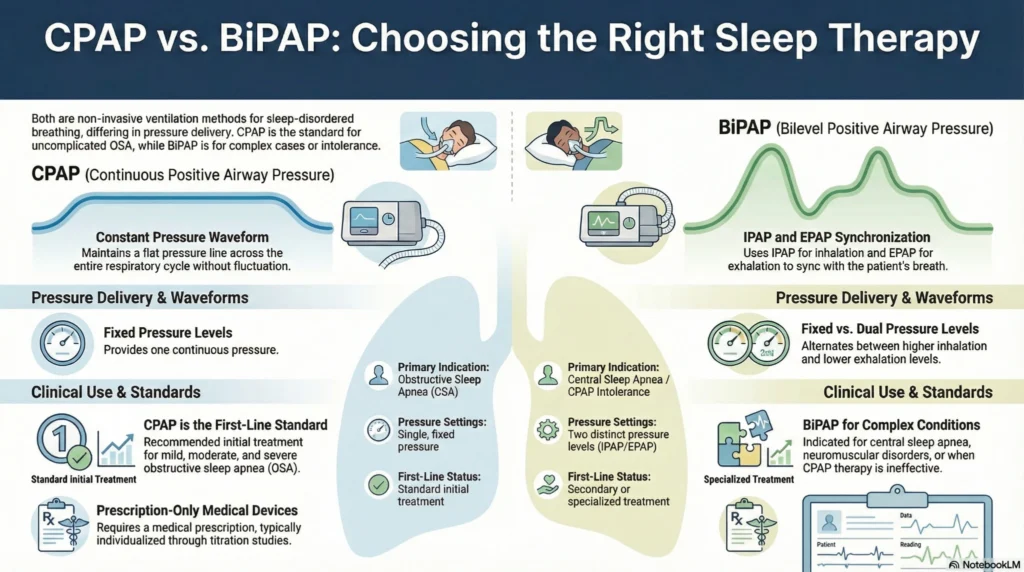
Choosing between CPAP vs BiPAP is a critical step in managing sleep apnea and respiratory health. While both provide positive airway pressure, they function differently to support your breathing. The primary difference lies in pressure delivery: CPAP provides one constant pressure level, while BiPAP (bilevel positive airway pressure) offers two distinct levels—higher for inhalation and lower for exhalation—making it ideal for complex cases like COPD or central sleep apnea.
The Mechanical Split: Constant vs. Bilevel Pressure
Understanding the engineering behind these devices helps demystify the treatment process. A Continuous Positive Airway Pressure (CPAP) machine is essentially a high-tech air compressor. It is designed to deliver a steady, unwavering stream of filtered air through a mask. This constant pressure acts as a pneumatic splint, preventing the soft tissues in the throat from collapsing, which is the hallmark of Obstructive Sleep Apnea (OSA). In most 2026 models, the focus has shifted toward whisper-quiet motors and auto-adjusting algorithms that can subtlely tweak that single pressure level based on your breath-to-breath needs, but the fundamental mechanic remains continuous.
The BiPAP machine, or bilevel positive airway pressure vs CPAP, operates on a more complex dual-pressure logic. It utilizes two distinct settings: Inspiratory Positive Airway Pressure (IPAP) and Expiratory Positive Airway Pressure (EPAP). When the machine detects you are beginning to inhale, it ramps up to the IPAP level to provide inspiratory pressure support. As soon as you begin to exhale, the machine instantly drops the pressure to the EPAP level. This mechanical shift significantly reduces the work of breathing, as you no longer have to push your lungs against a heavy wall of incoming air to get a breath out. For many patients, this exhalation pressure relief CPAP vs BiPAP difference is what makes long-term therapy tolerable.
Modern 2026 BiPAP devices are equipped with advanced sensors that can differentiate between various types of breathing events. These auto-adjusting algorithms are more sophisticated than those found in standard CPAP units, as they must balance the timing of the pressure shifts perfectly with the patient’s natural rhythm. This level of synchronization ensures that the airway stays open while keeping the user’s breathing effort at a minimum.
Who Needs a BiPAP Machine? Clinical Indications
While CPAP is the go-to first-line treatment for standard sleep apnea, a respiratory specialist may recommend BiPAP for patients with more specific medical profiles. According to recent clinical data, in a large-scale study of 2.62 million patients, 41% utilized CPAP devices, while 9% were treated with BiPAP or adaptive servo-ventilators. This suggests that while CPAP remains the dominant choice, a significant portion of the population requires the specialized support of bilevel therapy.
Individuals who need a BiPAP machine often fall into categories that involve more than just a physical blockage of the airway. For instance, BiPAP vs CPAP for COPD patients is a frequent discussion in clinical settings. Patients with Chronic Obstructive Pulmonary Disease often struggle with carbon dioxide clearance. Because BiPAP makes it easier to exhale fully, it helps the body vent CO2 more effectively than a constant pressure machine could.
Similarly, choosing between CPAP and BiPAP for central sleep apnea is a decision based on how the brain communicates with the breathing muscles. In Central Sleep Apnea (CSA), the problem isn't a blockage; it’s that the brain "forgets" to tell the body to breathe. BiPAP machines, particularly those with a "back-up rate" feature, can initiate a breath if the patient’s natural breathing pauses for too long. Other conditions that might necessitate a move to BiPAP include:
- Hypoventilation Syndrome: Where the patient does not breathe deeply or frequently enough to maintain healthy oxygen levels.
- Neuromuscular Disorders: Such as ALS or muscular dystrophy, where the muscles involved in breathing are weakened and need extra support during inhalation.
- High-Pressure Requirements: If your polysomnography findings suggest you need a pressure setting above 15 cm H2O, exhaling against that constant force becomes physically exhausting.
Despite these clinical distinctions, Continuous Positive Airway Pressure (CPAP) devices remain the most common treatment, accounting for an estimated 57.4% to 68% of global market share in 2025.
CPAP Intolerance: When and Why to Switch
One of the biggest hurdles in sleep medicine is therapy compliance. Many patients start with a standard machine but quickly find that they are struggling with CPAP intolerance and switching to BiPAP becomes the only way to save their treatment plan. If you find yourself waking up feeling like you are gasping for air, or if you are removing your mask in the middle of the night without realizing it, you may be experiencing intolerance.
Common signs that your CPAP pressure is too high include:
- Aerophagia: A condition where you "swallow air," leading to painful bloating, gas, and stomach discomfort in the morning.
- Difficulty Exhaling: A feeling of "fighting the machine" every time you try to breathe out.
- Leaking Masks: Higher pressures often compromise mask seal integrity, causing air to blow into the eyes or make loud whistling noises.
If these issues persist, your doctor will likely order a sleep titration study. During this study, technicians will monitor your sleep while testing different BiPAP pressure levels to find the "sweet spot" where your airway stays open but your exhalation remains natural. The impact of this switch is backed by data; a 2019 study found that 56.8% of patients who were initially non-compliant with CPAP or APAP therapy successfully achieved Medicare compliance criteria after switching to BiPAP therapy. This highlights how much of a difference airway resistance management can make for long-term health outcomes.
Cost, Portability, and 2026 Market Trends
When weighing BiPAP vs CPAP differences, the financial aspect is often the second most discussed topic after clinical efficacy. There is a notable price gap between the two technologies. A high-quality CPAP machine in 2026 typically costs between $500 and $1,000. In contrast, BiPAP machines are significantly more expensive, with prices ranging from $1,500 to $3,000 or more. The higher BiPAP vs CPAP cost comparison 2026 is due to the advanced sensors, dual-motor algorithms, and the specialized clinical software required to manage complex respiratory conditions.
Insurance coverage also differs. Most providers require documented "CPAP failure"—meaning you tried CPAP and it didn't work—before they will approve the higher cost of a BiPAP. You will likely need to provide data from your machine showing poor compliance or results from a follow-up titration study.
On the portability front, the news is much better. In the past, BiPAP machines were bulky, industrial-looking devices. However, 2026 models of portable BiPAP vs CPAP for travel have reached near parity. Most are now small enough to fit in a carry-on bag and include integrated heated humidifier settings that don't add significant bulk. Many manufacturers have also standardized the power bricks, making it easier to find battery backups for camping or international travel.
Decision Framework: The 3-Question Path
If you are currently looking at your options and feeling overwhelmed, use this simple framework to help guide your next conversation with your doctor.
The 3-Question Decision Path
- Do you have underlying lung or heart conditions? If you have been diagnosed with COPD, congestive heart failure, or a neuromuscular disorder, you are a strong candidate for BiPAP.
- Is your prescribed pressure above 15 cm H2O? High pressure is much harder to tolerate on a constant stream. If your OSA is severe, BiPAP may provide the relief you need to stay compliant.
- Do you struggle to exhale against a constant flow? If you feel like you are doing a "workout" just to breathe out, the dual-level pressure of a BiPAP is likely necessary for your comfort.
FAQ
What is the main difference between CPAP and BiPAP?
The core difference is how the air pressure is delivered to your airway. CPAP provides one continuous, fixed level of air pressure throughout your entire breath cycle. BiPAP provides two different levels: a higher pressure when you inhale and a lower pressure when you exhale, making it easier to breathe out against the machine.
Why would a doctor prescribe BiPAP instead of CPAP?
A doctor usually prescribes BiPAP if you have complex sleep apnea, COPD, or other respiratory issues that require help with carbon dioxide clearance. They may also prescribe it if you have tried CPAP and found the constant pressure too difficult to tolerate, or if you require very high pressure settings that make exhaling uncomfortable.
Is BiPAP more comfortable than CPAP?
For many people, yes. Because BiPAP reduces the pressure during exhalation, it feels more like natural breathing. It reduces the "work" your chest muscles have to do to push air out, which can prevent the feeling of suffocation or bloating that some people experience with a constant-pressure CPAP machine.
Which machine is better for central sleep apnea?
BiPAP is generally considered the better option for central sleep apnea. Unlike obstructive apnea, where the airway is blocked, central apnea occurs when the brain fails to signal the muscles to breathe. BiPAP machines can include a "timed" feature that will provide a breath of air if the machine detects you haven't taken a breath within a certain number of seconds.
Is BiPAP more expensive than CPAP?
Yes, BiPAP machines are significantly more expensive. While a standard CPAP might cost under $1,000, a BiPAP machine often costs between $1,500 and $3,000. This is due to the more advanced sensors and complex algorithms needed to synchronize two different pressure levels with your breathing.
Can you switch from CPAP to BiPAP?
Yes, many patients switch after discovering they are CPAP intolerant. If you are struggling with your current machine, you should speak to your doctor about a new titration study. If the study shows that you are more compliant and have better sleep quality on bilevel pressure, your doctor can write a new prescription for a BiPAP.