Quick Facts
- Entry Price: $299 for 2.5mg doses via LillyDirect.
- Savings: ~50% reduction from the $1,086 pen list price.
- Distribution: Exclusive to LillyDirect; no retail pharmacy access for vials.
- Admin Method: Manual syringe and needle required (not an auto-injector).
- Refill Window: 45 days for Self Pay Journey Program maintenance.
Eli Lilly has revolutionized obesity treatment accessibility with the launch of single-dose vials. The Zepbound vials cost is approximately 50% less than the standard pen injectors, starting at just $299 via LillyDirect. This guide explains how to navigate the Zepbound Self Pay Journey Program and master the self-administration process.
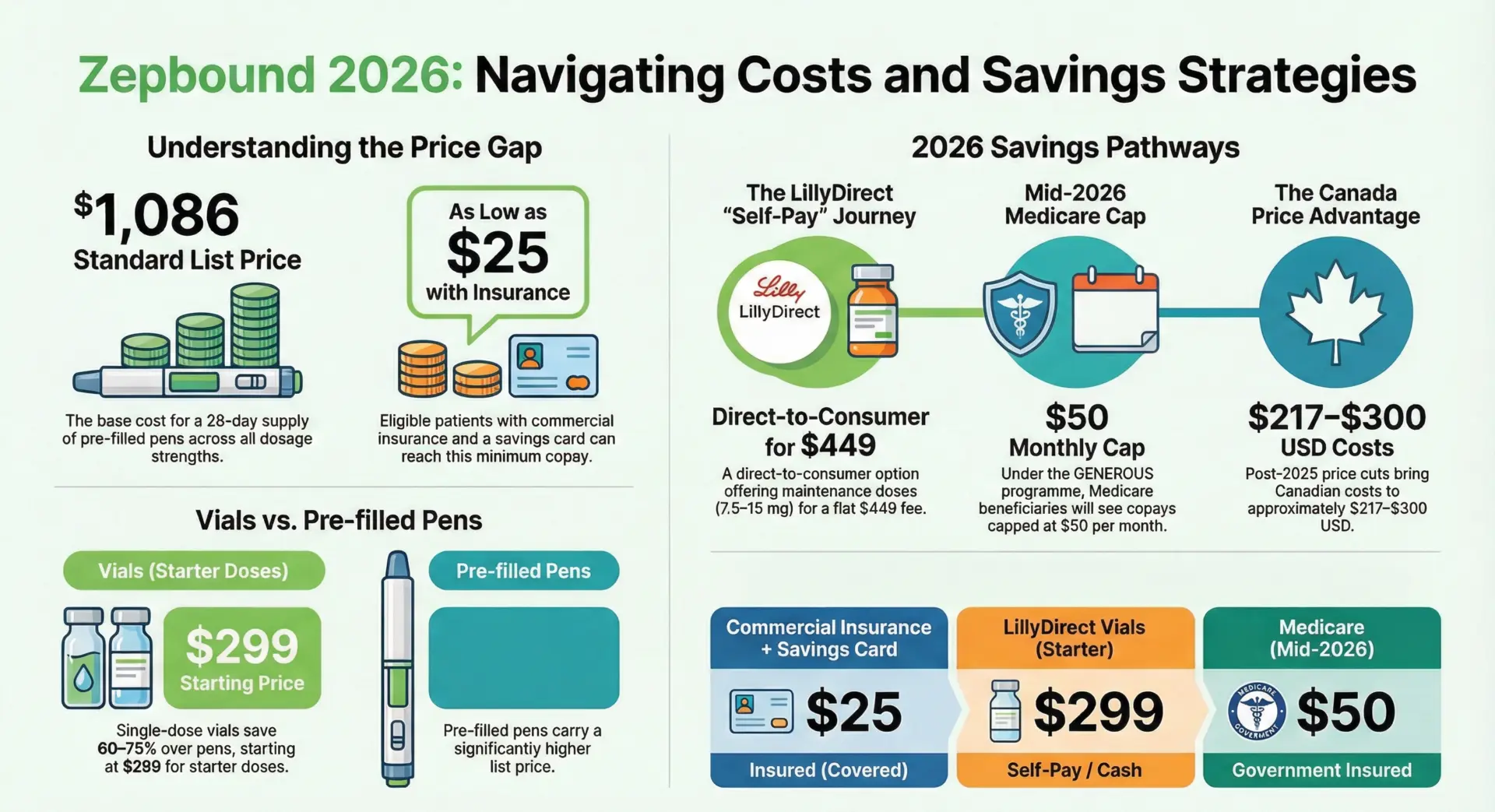
Zepbound single-dose vials purchased through LillyDirect significantly reduce out-of-pocket expenses for cash-paying patients. The 2.5 mg starter dose is priced at $299, while the 5 mg dose costs $399. Higher maintenance doses ranging from 7.5 mg to 15 mg are available for $449 per month through the Zepbound Self Pay Journey Program, provided refills are completed within 45 days of the previous delivery.

Zepbound Vial Pricing: 2026 Tiered Breakdown
The financial landscape for obesity treatment has shifted dramatically. For many patients, the primary barrier to Tirzepatide has been the list price of the auto-injector pens, which often hovers around $1,086.37. By introducing a vial format, Eli Lilly has effectively halved the entry cost for those without insurance coverage. When looking at a Zepbound vials vs pen injectors cost comparison, the savings are most evident at the starter doses.
In late 2024, the company launched single-dose Zepbound vials at a 2.5 mg dose for $399 and a 5 mg dose for $549 per month, a move that offered a 50% lower than the $1,059.87 list price of the automated delivery systems. This was followed by a strategic shift in December 2025, where Eli Lilly announced further price reductions for self-pay patients, bringing the 2.5 mg vial down to $299 and the 5 mg vial to $399.
| Component | Single-Dose Vials (LillyDirect) | Pre-filled Auto-Injector Pens |
|---|---|---|
| 2.5 mg Dose Cost | $299 | ~$1,086 |
| 5 mg Dose Cost | $399 | ~$1,086 |
| 7.5 mg Dose Cost | $449* | ~$1,086 |
| 10 mg Dose Cost | $449* | ~$1,086 |
| Administration | Manual syringe and needle | Integrated automated needle |
| Accessibility | LillyDirect Only | Most retail pharmacies |
Note: Pricing for 7.5 mg and 10 mg doses is available through the Zepbound Self Pay Journey Program for patients who maintain a consistent refill schedule.
The rationale behind the Zepbound vial pricing for 2.5mg and 5mg doses is to lower the barrier for patients just beginning their weight management journey. Because these starter doses are not intended for long-term maintenance, the lower price point allows patients to "on-ramp" to the medication without a massive initial investment. As patients move to higher doses, the company expanded its direct-to-consumer vial offerings to include 7.5 mg and 10 mg options to ensure continued affordability throughout the treatment cycle.
Access via LillyDirect: The Self Pay Journey Program
To obtain these lower prices, patients must navigate a specific fulfillment channel. The vials are not available at your local corner pharmacy; instead, they are distributed exclusively through a direct-to-consumer pharmacy model. This LillyDirect Zepbound vial access guide outlines the transition from a traditional prescription to the self-pay model.
The Zepbound Self Pay Journey Program is the engine behind these discounted rates. When a healthcare provider writes a prescription specifically for "Zepbound single-dose vials," it is sent to LillyDirect. Once the prescription fulfillment process begins, the patient is responsible for the out-of-pocket expense. It is important to note that these vials are designed for patients who do not have insurance coverage for GLP-1 receptor agonist medications or those who choose to pay cash to avoid complex prior authorization hurdles.
One critical administrative detail is the Zepbound Self Pay Journey Program refill requirements. To maintain the discounted pricing on maintenance doses (7.5 mg and above), patients must complete their refills within 45 days of their previous delivery. This window is designed to encourage treatment adherence, which is vital for the long-term success of any obesity treatment. If a patient misses this window, they may find the price reverts to a higher tier until they re-establish a consistent schedule.
Administration Guide: Switching from Pens to Vials
For many, the transition from an auto-injector pen to a vial can feel daunting. The pen hides the needle and automates the pressure; the vial requires a manual subcutaneous injection. However, once mastered, Zepbound single-dose vial self-administration is a straightforward process that offers more control over the injection.
Before you begin, ensure you have the necessary supplies needed for Zepbound vial injections. Unlike the pens, which are all-in-one, vials require external hardware:
- Insulin Syringes: Specifically 0.5 mL or 1 mL syringes with a fixed needle (usually 31G, 6mm or 8mm).
- Alcohol Swabs: For cleaning the vial stopper and the injection site.
- Gauze or Cotton Balls: To manage any minor spotting at the site.
- Sharps Container: For safe disposal of used needles and syringes.
Follow these Zepbound single-dose vial self-administration steps to ensure safety and efficacy:
- Prepare: Wash your hands and clean the top of the Tirzepatide vial with an alcohol swab.
- Draw Air: Pull the syringe plunger back to the mark corresponding to your dose (e.g., 0.5 mL) to draw air into the syringe.
- Equalize Pressure: Push the needle through the rubber stopper and inject the air into the vial. This makes it easier to draw the liquid out.
- Withdraw Medication: Invert the vial and pull the plunger back to the exact dose mark, ensuring there are no large air bubbles.
- Inject: Clean a site on your abdomen, thigh, or back of the arm. Insert the needle at a 90-degree angle and depress the plunger slowly.
- Dispose: Immediately place the used syringe in your sharps container.
It is recommended to allow the vial to sit at room temperature for about 30 minutes before injection to reduce any "sting." Vials remain stable at room temperature for up to 30 days, though they should generally be stored in the refrigerator until used.

Insurance and Future Coverage: Medicare 2026
The current landscape for Zepbound vials is primarily focused on the self-pay market. Because the vial program is priced significantly lower than the list price, it does not typically stack with commercial insurance or the Zepbound Savings Card in the same way the pens do. For those with commercial insurance that does cover weight loss meds, the Savings Card can still bring the price of pens down to as low as $25.
However, a major shift is on the horizon for 2026. Under the Zepbound Medicare copay 2026 GENEROUS program, there is a broad expectation that coverage for obesity treatment medications will expand significantly. Starting in mid-2026, eligible Medicare beneficiaries may see a $50 monthly copay for these life-changing treatments. This would eliminate the need for many seniors to rely on the cash-pay vial system, providing a more traditional pharmacy experience.
In the meantime, patients often look at international benchmarks for pricing context. For example, in Canada, Tirzepatide options currently range between $217 and $300 USD. While the $299 price point in the U.S. for the 2.5 mg vial brings domestic costs much closer to international standards, the U.S. market remains unique due to its direct-to-consumer pharmacy distribution through LillyDirect.

FAQ
How much do Zepbound vials cost?
The cost depends on the dosage and your enrollment in the self-pay program. The 2.5 mg starter dose is $299 per month, while the 5 mg dose is $399. Higher doses range from $449 up to approximately $1,049 depending on the specific maintenance tier and refill consistency.
Are Zepbound vials cheaper than the pens?
Yes, for patients paying out-of-pocket, the vials represent a savings of roughly 50%. The retail list price for the auto-injector pens is about $1,086, making the $299 and $399 vial options a significantly more affordable choice for those without insurance coverage.
What doses are available in vial form for Zepbound?
Currently, Eli Lilly offers the 2.5 mg and 5 mg doses in single-dose vials as part of the initial rollout. In early 2025, the program expanded to include higher maintenance doses like 7.5 mg and 10 mg to accommodate patients who need to titrate up for continued weight loss results.
Does insurance cover the cost of Zepbound vials?
Generally, the discounted vial pricing is intended for "self-pay" patients who do not have insurance coverage for the drug. While some commercial plans might reimburse a portion of the cost, the LillyDirect vial program is specifically designed to bypass the traditional insurance billing process to provide a lower, transparent cash price.
How many doses are in one Zepbound vial?
Each Zepbound vial is a "single-dose" container. This means it contains exactly one dose (0.5 mL of liquid) intended for one-time use. Unlike some other insulin or multi-dose vials, you should not attempt to draw multiple doses from a single Zepbound vial, as it does not contain the preservatives necessary for multiple entries.
Choosing between vials and pens often comes down to a simple trade-off: the convenience of an automated device versus the substantial financial savings of a manual injection. If you are ready to make the switch, the first step is to consult your healthcare provider to discuss a new prescription for the vial format. With the Zepbound vials cost now at its lowest point yet, the path to sustainable weight management has never been more accessible.