Quick Facts
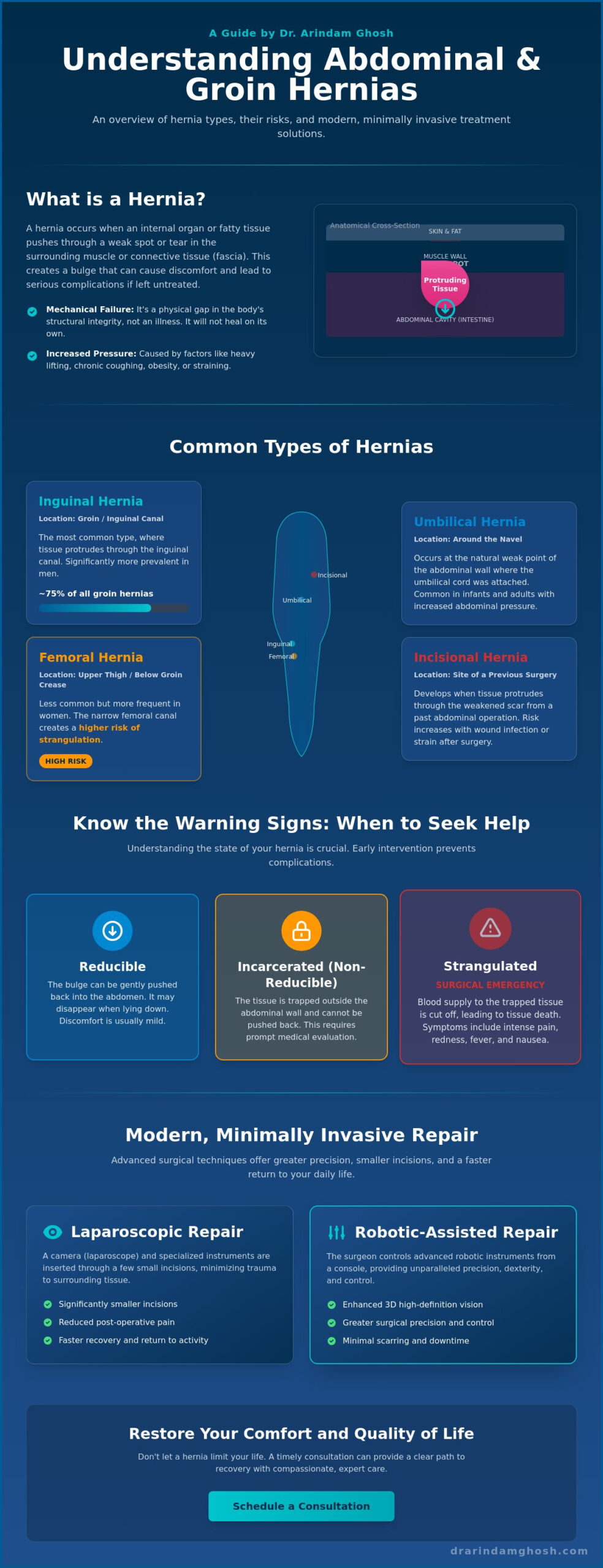
- Prevalence: Inguinal hernias are the most common, making up 75% of cases and affecting roughly 25% of men.
- Mechanical Nature: Most hernias are physical defects in the abdominal wall and do not heal without intervention.
- Success Rate: The use of synthetic mesh in repairs is the gold standard, reducing recurrence rates to just 1% to 2%.
- Recovery Time: Patients undergoing minimally invasive procedures often return to light activity within 1 to 2 weeks.
- Emergency Risk: Femoral hernias carry the highest risk of strangulation and often require urgent surgical treatment.
- Non-Surgical Limits: While watchful waiting is an option for some, it is generally a delay of surgery rather than a cure.
Hernia treatment options generally fall into two categories: surgical repair and non-surgical management. While small, asymptomatic bulges might be monitored through watchful waiting, symptomatic hernias usually require surgery to prevent complications like strangulation. Modern techniques, including laparoscopic and robotic repair, offer faster recovery times. Surgical hernia repair techniques are designed to reinforce the abdominal wall, often using mesh to provide a permanent solution to the underlying structural weakness.
Emergency Red Flags: When Surgery is Urgent
Understanding the signs of a hernia is one thing, but recognizing a medical emergency is critical. A hernia becomes dangerous when the protruding tissue becomes trapped and cannot be pushed back in, a condition known as an incarcerated hernia. If the blood supply to that trapped tissue is cut off, it becomes a strangulated bowel or strangulated tissue, which is a life-threatening emergency.
Because of the narrow opening of the femoral canal, femoral hernias are particularly prone to these complications. If you have been diagnosed with a femoral hernia, your doctor will likely explain why femoral hernias require urgent surgical treatment compared to other types.
Seek Immediate Emergency Care If You Experience:
- Sudden, intense pain at the hernia site that rapidly worsens.
- A hernia bulge that turns red, purple, or dark.
- Nausea and vomiting.
- Fever and a rapid heart rate.
- Inability to pass gas or have a bowel movement.
- Constant, firm pressure or tenderness over the bulge.
These signs of hernia strangulation that require immediate ER visit should never be ignored. In these cases, the window for a successful repair without permanent bowel damage is very narrow.
The 4 Common Hernia Types and Their Symptoms
To understand your hernia treatment options, you must first identify which type of abdominal wall defect you are dealing with. While the core issue—internal tissue pushing through a weak spot—is the same, the location and risks vary significantly.
1. Inguinal Hernia
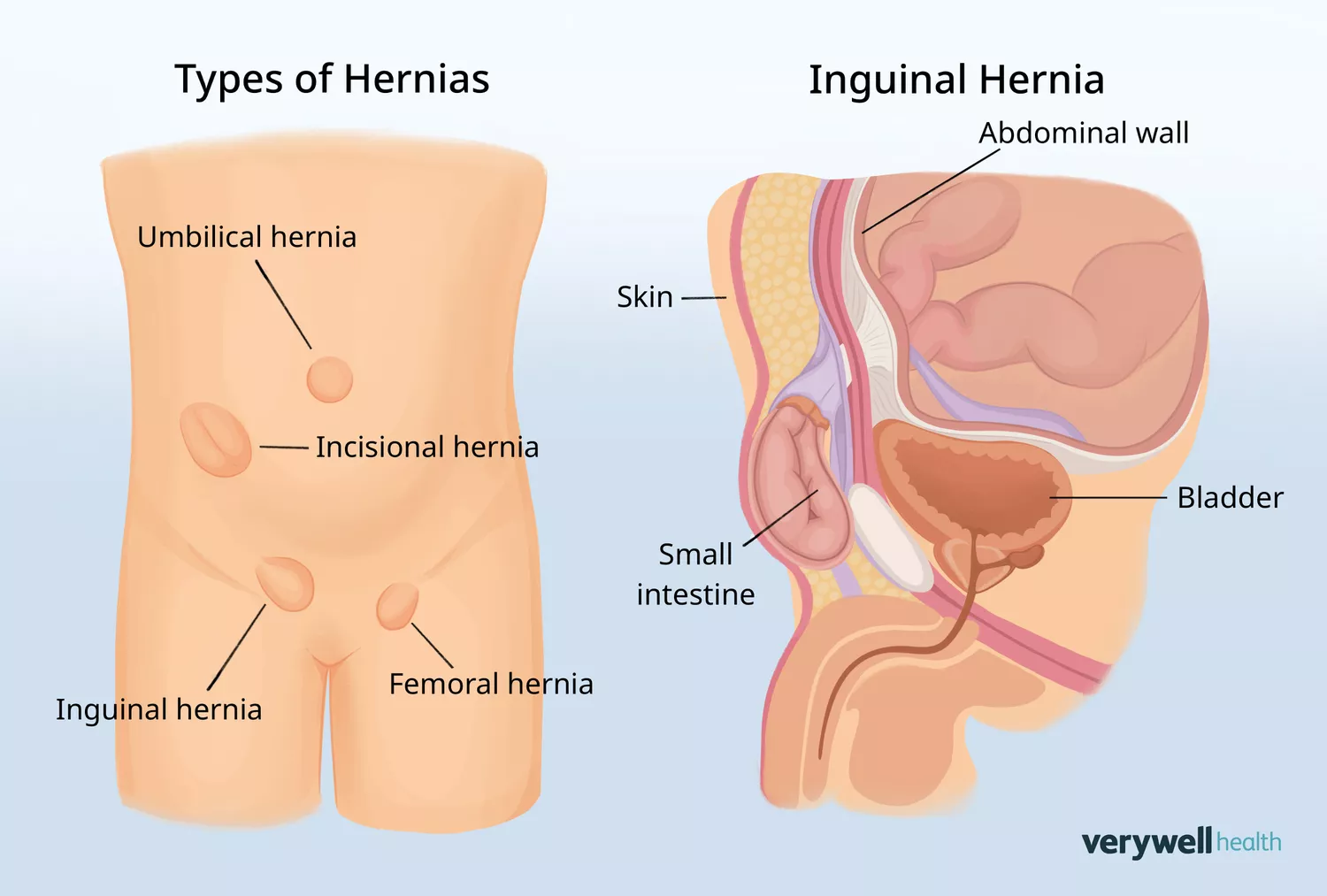
The inguinal hernia is by far the most prevalent, accounting for 75% of all cases. These occur in the groin area when fatty tissue or a part of the intestine pokes through the inguinal canal. You might notice a dull ache or a tugging sensation that worsens when you cough, bend over, or lift heavy objects. It affects about 25% of men but only 2% of women.
2. Femoral Hernia
Often mistaken for an inguinal hernia because of its proximity to the groin, a femoral hernia occurs just below the groin crease in the upper thigh. These are much more common in women, particularly older women. While they may appear as an asymptomatic bulge at first, they are notoriously difficult to reduce and carry a high risk of trapping the bowel.
3. Umbilical Hernia
These occur at or near the belly button (the umbilicus). In adults, umbilical hernias are often caused by abdominal strain from obesity, multiple pregnancies, or heavy lifting. You may see a visible protrusion that becomes more prominent when you strain your core muscles.
4. Incisional Hernia
An incisional hernia occurs at the site of a previous surgical scar. It is estimated that these develop in 15% to 20% of patients who have undergone abdominal surgery. The previous incision creates a permanent weak point in the muscle wall, which can give way over time. This type is often classified as a ventral hernia, a broader term for hernias occurring on the front of the abdomen.
Non-Surgical Hernia Management Options: Limitations vs. Reality
When a patient first discovers a bulge, the most common question is whether it can be managed without going under the knife. For patients with a small, asymptomatic bulge that causes no pain, a doctor may recommend watchful waiting. This involves regular check-ups to ensure the hernia isn't growing or becoming symptomatic.
However, it is vital to have a realistic perspective on non-surgical hernia management options. Because a hernia is a physical hole in the muscle, it cannot heal itself through exercise, medication, or diet. Some patients turn to hernia belts or trusses—elastic garments designed to hold the bulge in place—but these are temporary fixes at best. In fact, relying on a belt for too long can sometimes cause scarring or make the eventual surgical repair more difficult.
When discussing how to decide between hernia surgery and watchful waiting, consider your lifestyle. If you enjoy an active life or have a job that requires physical labor, the risk of a hernia becoming symptomatic or incarcerated is higher. Lifestyle modifications, such as maintaining a healthy weight and adhering to heavy lifting restrictions, can help manage symptoms but will not close the defect.
Modern Surgical Hernia Repair Techniques
If you and your surgeon decide that a repair is necessary, you will likely choose between a traditional open approach and a minimally invasive approach. The primary goal of any surgery is to return the displaced tissue to its proper place and reinforce the abdominal wall.
Surgical repair using synthetic mesh is the gold standard, as it significantly reduces the recurrence rate to approximately 1% to 2% compared to repairs that only use sutures. This "tension-free" repair allows the body’s natural tissue to grow into the mesh, creating a strong, reinforced barrier.
| Feature | Open Surgery | Laparoscopic Surgery | Robotic-Assisted Surgery |
|---|---|---|---|
| Incision Size | One large incision (3-6 inches) | 3-4 tiny incisions (<1 inch) | 3-4 tiny incisions (<1 inch) |
| Recovery Time | 4-6 weeks for full activity | 1-2 weeks for light activity | 1-2 weeks for light activity |
| Anesthesia | Local, spinal, or general | General | General |
| Best For | Complex or recurrent hernias | Bilateral or standard inguinal | Complex ventral or incisional |
Laparoscopic surgery uses a thin tube with a camera (laparoscope) inserted through a small incision, allowing the surgeon to work inside the abdomen without a large opening. Robotic surgery is an evolution of this, offering the surgeon enhanced 3D visibility and greater precision. Many patients prefer these methods because they often result in less postoperative pain and a faster return to daily life. However, when comparing the recovery time for laparoscopic vs robotic hernia repair, they are generally similar, with the robotic platform providing an edge in more complex abdominal wall reconstructions.
Postoperative Recovery: What to Expect
The journey doesn't end when you leave the operating room. Your focus then shifts to protecting the repair. During the initial 24 to 48 hours of postoperative recovery, you may feel some soreness and swelling. Most patients can walk around the day of surgery, which is actually encouraged to prevent blood clots.
In the first 1 to 2 weeks, you should stick to light-duty activities. This means no strenuous exercise and strictly following heavy lifting restrictions—usually nothing heavier than a gallon of milk. By the 4 to 6-week mark, most patients are cleared for full activity, including sports and heavy lifting.
To ensure long-term success, you should learn how to prevent hernia recurrence after surgical repair. This involves managing chronic coughs, avoiding constipation (which causes straining), and strengthening your core muscles once cleared by your doctor.
Before your procedure, make sure to prepare a list of questions to ask a surgeon about hernia repair options. Ask about the type of mesh they use, their experience with the robotic platform, and what your specific timeline for returning to work looks like.
FAQ
Can a hernia go away without surgery?
No, a hernia is a mechanical structural defect in the muscle wall. While symptoms may fluctuate or disappear temporarily with rest, the hole in the abdominal wall will not close on its own. Surgery is the only way to permanently repair the defect.
Is laparoscopic or open surgery better for hernia repair?
The best approach depends on the hernia type, your medical history, and the surgeon's expertise. Laparoscopic surgery generally offers a faster recovery and less pain, making it ideal for standard groin hernias. Open surgery may be preferred for very large hernias or for patients who have had extensive previous abdominal surgeries.
What happens if a hernia is left untreated?
An untreated hernia may grow larger over time, making the eventual surgery more complex. The most significant risk is incarceration or strangulation, where the bowel becomes trapped and its blood supply is cut off, leading to a life-threatening emergency that requires immediate surgery.
What are the non-surgical treatment options for a hernia?
Non-surgical options are limited to watchful waiting for asymptomatic hernias and lifestyle modifications like weight loss or avoiding heavy lifting. Some patients use a hernia belt for temporary support, but these do not fix the underlying problem and are not a long-term solution.
How long does it take to recover from hernia surgery?
Most patients undergoing minimally invasive repairs can return to light activity and sedentary work within 1 to 2 weeks. However, full recovery and permission to engage in heavy lifting or strenuous exercise typically take 4 to 6 weeks to ensure the tissue has properly integrated with the mesh.
Conclusion
Navigating hernia treatment options can feel overwhelming, but it helps to view the condition through the metaphor of a pressurized container. When the container wall fails, the solution is a mechanical reinforcement. Whether you are managing an inguinal and femoral hernia treatments plan or preparing for a ventral repair, the goal is the same: to restore your quality of life and prevent dangerous complications.
By staying informed about the signs of strangulation and understanding the benefits of modern surgical hernia repair techniques, you can make a decision that ensures long-term health. Don't wait for a dull ache to become a surgical emergency; consult with a specialist to discuss which path to repair is right for you.